
Lonoke County ground is mostly clay, and clay moves. It swells when it's wet and shrinks when it dries out, and Cabot gets both extremes in the same year, soaking spring rains in April and May, then a hard, dry stretch through July and August when the yard cracks. A deck footing that isn't deep enough, or isn't poured on undisturbed soil, will heave a little every winter and settle a little every summer. After a few years that shows up as a deck that's pulled an inch off the house, or a post that's rocking in its footing. Any builder working in this area should already know to go below the frost line, generally 12 to 18 inches here, and most good crews go deeper than code minimum in clay just to keep that movement from reaching the frame. If a builder can't tell you how deep their footings go and why, that's worth noticing.
What a real bid actually tells you
A one-page estimate with a dollar total and nothing else isn't a bid, it's a guess. A proper quote spells out footing size and depth, joist spacing, the species or brand of decking, the hardware being used, and what happens with the ledger board where the deck meets the house. That last point matters more than people think. The ledger is bolted to the house rim joist and carries a big share of the deck's weight, and if it's not flashed correctly, water gets behind it and rots the band joist from the inside, where you can't see it until the deck starts to sag. Ask how they're attaching the ledger. "Lag screws into the rim joist, flashed with a drip cap" is a real answer. A shrug is not.
Ask for proof of license and liability insurance, not because most builders in this area are unlicensed, but because the ones who aren't are the ones who disappear halfway through a job. Workers' comp matters too. If someone falls off a ladder on your property and the contractor has no coverage, that claim can land on your homeowner's policy.
Materials: what holds up here and what doesn't
Pressure-treated southern yellow pine is still the standard framing material around Cabot, and it's fine for joists and beams as long as the fasteners match it. Treated lumber today is made with a different chemical than it was 20 years ago, and it eats plain galvanized nails and screws over time. Hardware needs to be stainless steel or a coating rated for ACQ-treated lumber, usually labeled G185 hot-dip galvanized or better. A builder using whatever deck screws were on sale is setting you up for rusted fasteners and streaked decking in five years.
For the decking surface itself, you're choosing between treated pine, cedar, and composite. Treated pine is the cheapest and needs staining or sealing every 2 to 3 years in this climate, because the summer sun here is hard on exposed wood and UV breaks down a finish fast. Composite costs more up front but doesn't need that upkeep, and it handles the humidity we get June through September without cupping the way wood boards sometimes do. Neither one is wrong, it depends on whether you'd rather pay now or maintain later.
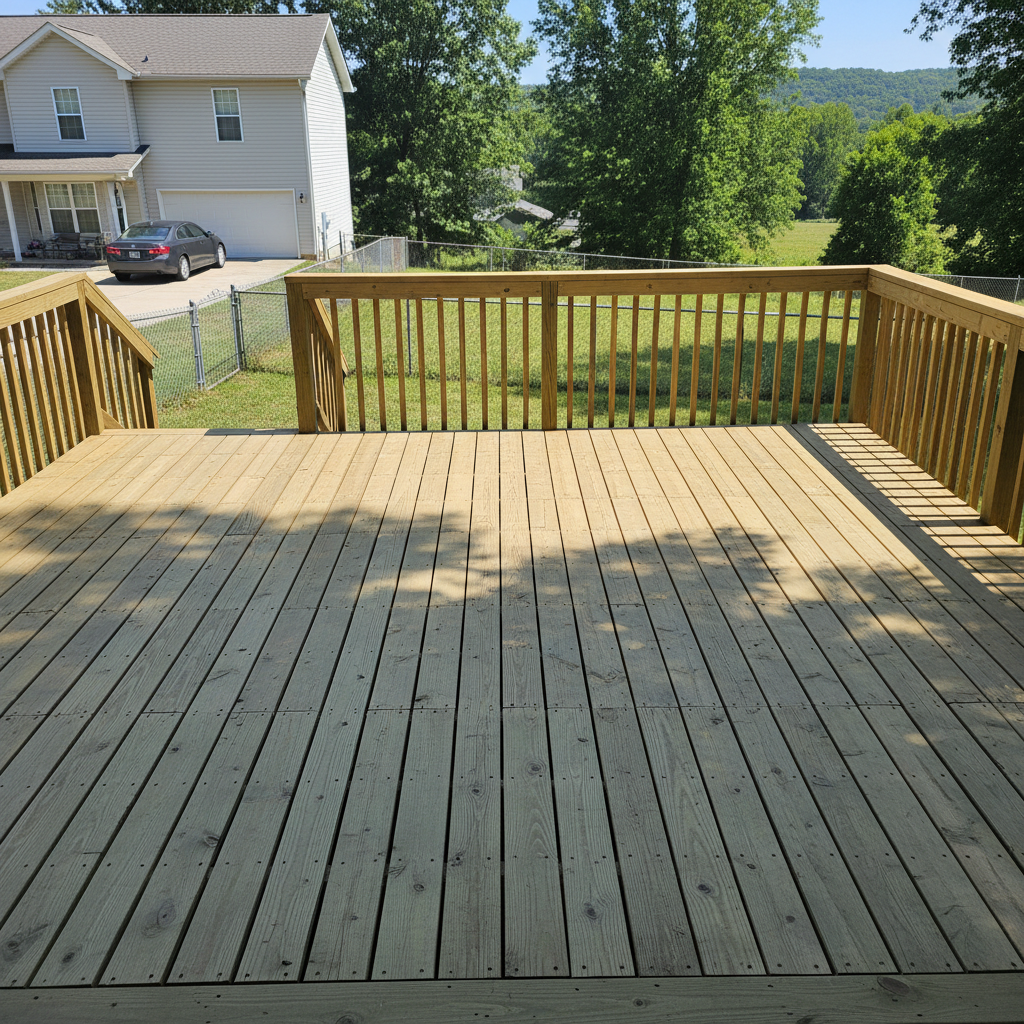
Railing is where corners get cut. Code generally requires guardrails for any deck surface more than 30 inches above grade, with balusters spaced so a 4-inch sphere can't pass through. A builder who's vague on baluster spacing, or who wants to use undersized deck screws to toe-nail a rail into place instead of proper post-to-beam connections with structural screws or through-bolts, is building something that'll wobble under a cookout crowd.
How permits actually work here
Most attached decks in Cabot need a building permit through the city, and that usually means an inspection of the footings before concrete gets poured, and a framing inspection before the decking boards go down. If your lot is in one of the newer subdivisions on the edge of town, there's a decent chance there's an HOA with its own rules on setback and even deck color, on top of whatever the city requires. Older lots closer to downtown Cabot don't usually have that layer, but they sometimes have the opposite problem: a 1970s or 80s house with an undersized rim joist or old wiring and plumbing already running where a footing needs to go, which only shows up once you start digging. A builder who tells you permits aren't necessary for your project, without having actually looked at your plans or your lot, is either guessing or hoping you won't ask again.
Red flags worth walking away from
- A price that's dramatically lower than every other bid, with no explanation of what's different about the materials or footings.
- Pressure to sign and pay a large deposit the same day, before you've seen a written scope.
- No mention of flashing at the ledger board, or a plan to just caulk it instead.
- Footings described as "we'll just set posts on concrete blocks," which doesn't meet code for anything attached to the house and won't survive a wet Arkansas winter.
- Vague answers about who pulls the permit, or a suggestion to skip it to save time.
None of this means you need the most expensive bid on the table. It means you need a builder who can explain their choices in plain terms, because the parts of a deck that actually fail, the footings, the ledger, the fasteners, are mostly buried or hidden once the project's done. You're trusting the work you can't see based on how clearly someone talks about it before they start.
We build and repair decks all over Cabot and the towns around it, and we're happy to walk a homeowner through footing depth, ledger flashing, or composite versus wood before any money changes hands. You can see more about the kind of work we do at Northstar Deck Co.